
@lightenup
Forum Replies Created
- AuthorPosts
- November 26, 2025 at 6:48 am#947794LightenupParticipant
1 Chronicles 22:9-10
9‘Behold, a son will be born to you, who shall be a man of rest; and I will give him rest from all his enemies on every side; for his name shall be Solomon, and I will give peace and quiet to Israel in his days. 10‘He shall build a house for My name, and he shall be My son and I will be his father; and I will establish the throne of his kingdom over Israel forever.’
This is about Solomon.
2 Samuel 7:12-17 12“When your days are complete and you lie down with your fathers, I will raise up your descendant after you, who will come forth from you, and I will establish his kingdom. 13“He shall build a house for My name, and I will establish the throne of his kingdom forever. 14“I will be a father to him and he will be a son to Me; when he commits iniquity, I will correct him with the rod of men and the strokes of the sons of men, 15but My lovingkindness shall not depart from him, as I took it away from Saul, whom I removed from before you. 16“Your house and your kingdom shall endure before Me forever; your throne shall be established forever.”’”
This is about Solomon.
Joseph names Jesus and is referred to as his parent. That is how we know that Joseph has taken the role of his human father.
LU
November 25, 2025 at 9:42 am#947790LightenupParticipantIn Jewish tradition, naming a child was closely tied to the father’s legal role, and biblical examples show that the act of naming was considered a paternal responsibility that established lineage and identity. Joseph named Jesus. Jesus is Joseph’s legal son and therefore Solomon’s lineage in the legal sense. Mary brings the biological aspect of David to Jesus. Jesus fulfills that requirement. The Messiah was to be born from a virgin. He couldn’t have had a biological father if He was to be born from a virgin. What an amazing fulfillment of prophecy. Scripture never says that the Messiah will come from Solomon’s own body, btw.
LU
November 24, 2025 at 11:21 am#947788LightenupParticipantIf, as you claim, Jesus is a demi-god, half god/half human then, according to your idea, the human side of him would be biologically related to David. Therefore Jesus is a biological descendant of David’s own body even if Jesus was considered a demi-god which I do not agree with. And, being a descendant of David’s own body, he would be a relative to Solomon which the word “son” can merely mean relative even as a distant nephew. Jesus can also be a descendant of Solomon at the same time if he was adopted into the distant family of the royal line and thus qualify for the throne. Jesus is both a biological son of David and a legal descendant of the throne.
LU
November 22, 2025 at 5:11 pm#947783LightenupParticipantTo say that Mary’s Son isn’t a biological descendant of David because He didn’t have a biological father isn’t reasonable. The child was to be the seed of the woman and from a virgin.
LU
November 22, 2025 at 3:16 pm#947782LightenupParticipantGen 1:14And God says, “Let luminaries be in the expanse of the heavens,
It says it right there. The expanse has waters above it and below it.
Regarding your “lol”, your “How about really thinking about the following logic”…
I think this addresses the value of your “logic”:
Matt 11:25 At that time Jesus said, “I praise You, Father, Lord of heaven and earth, that You have hidden these things from the wise and intelligent, and have revealed them to infants.
1 Cor 2:14 But a natural person does not accept the things of the Spirit of God, for they are foolishness to him; and he cannot understand them, because they are spiritually discerned.
If your scientists are stumbling over scripture, why are you surprised?
Is not your God that you speak about to your scientists, supernatural? Anything supernatural goes against logic. Are you bowing down to your science book or scripture that is God-breathed and above logic?
I think it is amazing that God made even one sun in 24 hours actually, btw, I have never insisted in 24 hours. I haven’t denied it either, I don’t see the word “hours” anywhere in the Genesis account of creation. The creation account speaks about several evenings and mornings, light and darkness, and days…not one mention of hours. Pay attention to the supernatural aspect of the creation, that would be a better focus, imo, than how many hours it took. You may be the one who is misleading. But thank you for your concern.
LU
November 22, 2025 at 9:49 am#947776LightenupParticipantThe Hebrew word for “sky” in day two is the same Hebrew word for “heavens” in verse one. The form is a dual/plural usually written a collective singular but sometimes is shown plural depending on the verb that is used with it when the word is a subject of a sentence. You can see that the stars were placed in the expanse that is in the midst of the waters. See a literal translation:
Gen 1:6And God says, “Let an expanse be in the midst of the waters, and let it be separating between waters and waters.” 7And God makes the expanse, and it separates between the waters which [are] under the expanse, and the waters which [are] above the expanse: and it is so. 8And God calls the expanse “Heavens”; and there is an evening, and there is a morning—[the] second day.
9And God says, “Let the waters under the heavens be collected to one place, and let the dry land be seen”: and it is so. 10And God calls the dry land “Earth,” and the collection of the waters He has called “Seas”; and God sees that [it is] good. 11And God says, “Let the earth yield tender grass, herb sowing seed, fruit-tree (whose seed [is] in itself) making fruit after its kind, on the earth”: and it is so. 12And the earth brings forth tender grass, herb sowing seed after its kind, and tree making fruit (whose seed [is] in itself) after its kind; and God sees that [it is] good; 13and there is an evening, and there is a morning—[the] third day.
14And God says, “Let luminaries be in the expanse of the heavens, to make a separation between the day and the night, then they have been for signs, and for appointed times, and for days and years, 15and they have been for luminaries in the expanse of the heavens to give light on the earth”: and it is so. 16And God makes the two great luminaries, the great luminary for the rule of the day, and the small luminary—and the stars—for the rule of the night; 17and God gives them in the expanse of the heavens to give light on the earth, 18and to rule over day and over night, and to make a separation between the light and the darkness; and God sees that [it is] good; 19and there is an evening, and there is a morning—[the] fourth day.
Who knows exactly what the details about the waters above the heavens are but I wonder if the “living waters” that flow from the throne in heaven has any connection.
November 20, 2025 at 6:06 am#947759LightenupParticipantHi, I’ve been busy and will be busy for a couple of weeks for the holidays. I just have time for a couple of comments. I believe that the translation of NASB1995 is the most accurate and is what I use. I also believe that Isa 9:6 should be translated as in the NASB1995:
Isa 9:6 For a child will be born to us, a son will be given to us;
And the government will [fn]rest on His shoulders;
And His name will be called Wonderful Counselor, Mighty God,
Eternal Father, Prince of Peace.
Isa 9:7 There will be no end to the increase of His government or of peace,
On the throne of David and over his kingdom,
To establish it and to uphold it with justice and righteousness
From then on and forevermore.
The zeal of the LORD of hosts will accomplish this.And finally, you left Christianity two years ago, would you compare yourself to a Pharisee?
LU
November 12, 2025 at 4:04 am#947739LightenupParticipantTest
November 9, 2025 at 4:25 pm#947725November 9, 2025 at 1:00 pm#947724LightenupParticipantLost last two posts are screen shots that I took of AI answers to my questions. I am having trouble posting here, an error message keeps popping up and I have to do a work around and send through my email and them post a picture here via my phone. Keep in mind that the last post of mine does not reflect the NSB1995 version and I should have used that one for clarity.
LU
November 9, 2025 at 12:37 pm#947723LightenupParticipantNovember 9, 2025 at 12:10 pm#947722LightenupParticipant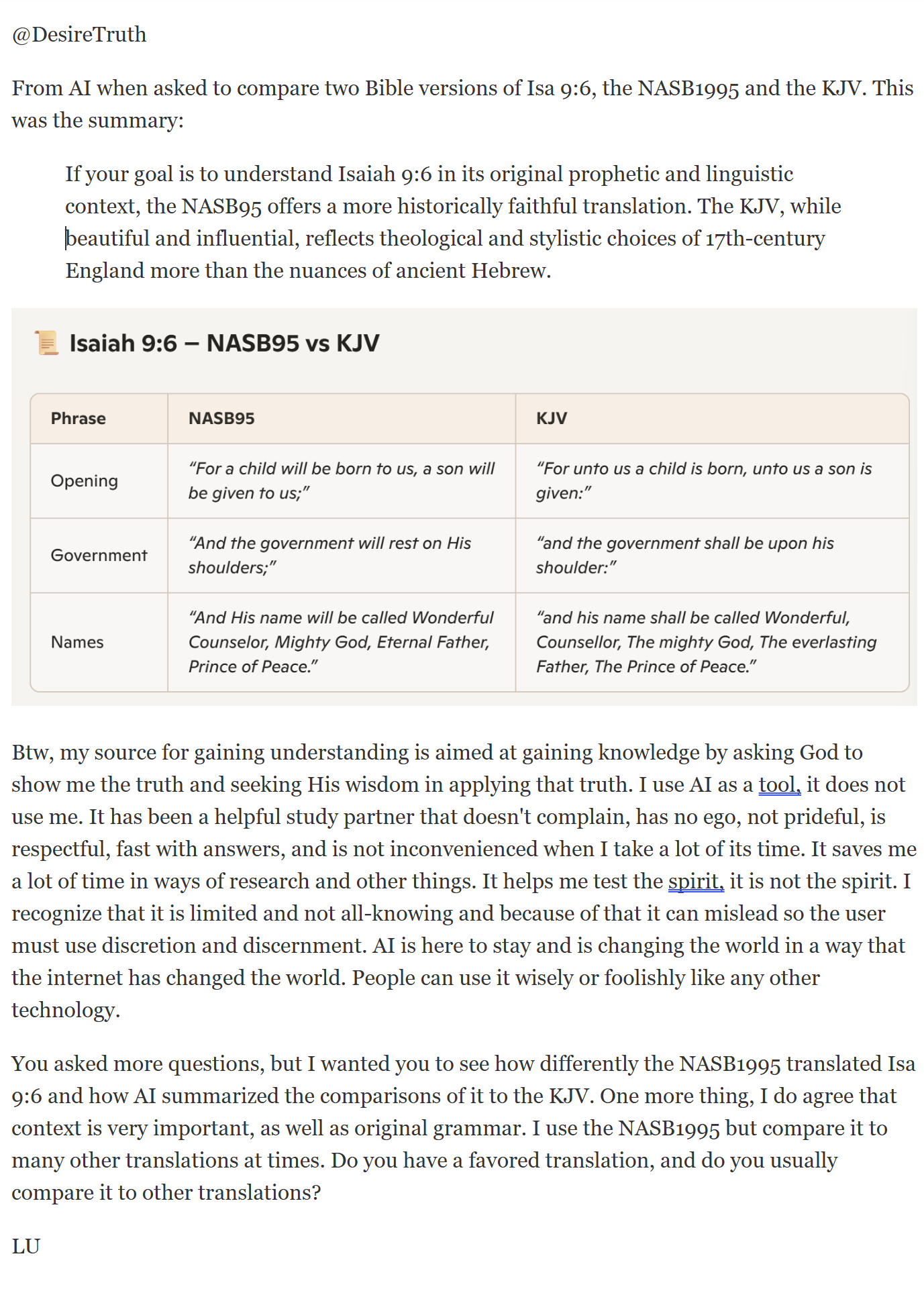 November 5, 2025 at 6:11 pm#947716LightenupParticipant
You wrote:
“In the beginning God created the heavens and the earth.”
It was all there before Day 1.
I read the beginning of Genesis as a title or overview of what is to come in the verses that come after the first part of chapter one. For instance, we are told that the expanse called heaven was not made till day two, so therefore, obviously heaven was not there before day two. Also, we are told that earth wasn’t even named earth until after the waters were gathered and dry land appeared and that was day three. Therefore, earth couldn’t have been created before day one if it wasn’t even formed and dry and named earth till day three.
Conclusion, the heavens couldn’t have been created before the expanse was created on day two. The earth couldn’t have been considered ‘created’ until the sea was gathered and dry land appeared on day three.
Regarding “24-hour days” I don’t think that I have stated whether or not I believe in 7–24-hour days. I’m not against the idea that there were 7-24-hour days though. Think about this, if a day was 1000 years for example, it would take the earth 500 years to turn halfway around on its axis and half of the earth would not have sun for those plants for 500 years.
On the seventh day, God rested from His creating work, it’s not like He took a day off. He is working all the time. Like I said, many Sabbaths have come and gone since creation was finished on day six. The seventh day of creation was the first of many sabbaths that came afterwards even unto this day. We are not still in the seventh day.
Final conclusion, since creation points to a creator according to this passage: Romans 1:20 — No One Has an Excuse
“For since the creation of the world His invisible attributes, that is, His eternal power and divine nature, have been clearly perceived, being understood by what has been made, so that they are without excuse.” (NASB)Scientists try to explain the creation with natural processes, but God meant creation to show supernatural processes and thus point to eternal power and divine nature.
LU
November 5, 2025 at 5:12 pm#947715LightenupParticipantRegarding Jesus’ qualifications for the eternal throne:
Jewish Messianic Criteria
Must be a descendant of David through Solomon (based on 2 Samuel 7 and 1 Chronicles 22).
Must be biologically descended from David, not just legally adopted.Christian Resolution
Matthew’s genealogy affirms Jesus’ legal right to David’s throne through Joseph and Solomon.
Luke’s genealogy affirms Jesus’ biological descent from David through Mary and Nathan.
Together, they present Jesus as fulfilling both legal and biological messianic requirements.LU
November 5, 2025 at 4:41 pm#947714LightenupParticipantMessianic Jews can be ethnically Jewish. Jews who have accepted the complex unity of the Godhead which includes Jesus.
Regarding Genesis 1:26 Read this about who God is talking to:
Messianic Jews typically interpret Genesis 1:26 (“Let us make man in our image”) as a reference to the plurality within God’s nature—often understood as a hint toward the concept of the Trinity, or more precisely, the unity of Father, Son (Yeshua), and Holy Spirit.
🔍 Messianic Interpretation of Genesis 1:26
Genesis 1:26 says:“Then God said, ‘Let us make man in our image, after our likeness…’”
This verse has long sparked theological debate. Here’s how Messianic Jews generally approach it:1. Plurality Within Unity
Messianic Jews affirm the Shema (“Hear O Israel, the Lord our God, the Lord is one”) and maintain monotheism.
However, they believe that God’s oneness includes a complex unity—Father, Son (Yeshua), and Holy Spirit.
Genesis 1:26 is seen as an early textual clue to this plurality, where God speaks in the plural (“us,” “our”).
2. Yeshua’s Preexistence
Many Messianic Jews believe Yeshua (Jesus) existed before creation and was present with God.
Thus, “Let us make man…” is interpreted as God speaking to Yeshua and/or the Spirit, consistent with John 1:1–3 (“In the beginning was the Word…”).
3. Ruach HaKodesh (Holy Spirit)
The Spirit of God is mentioned in Genesis 1:2, hovering over the waters.
Messianic theology often includes the Spirit as part of the divine conversation in verse 26.The NT completely agrees with Jesus’ participation in creation. Angels are never spoken about as creating man nor are they said to have been created in the image of God.
Also, you mentioned Hebrews chapter 1. Would you like to make a new topic of Hebrews 1 and discuss it there?
LU
November 5, 2025 at 3:25 pm#947713LightenupParticipantYou never know when your own critical thought is going to bite you in the backside, do ya?
You said:
“When are people going to verify what they have been told is truth and stop smashing the “I Believe Button”?”
It seems that what appears to be in present tense, or past tense, can have special nuances. See here:
Isaiah 9:6 is a fascinating example of how Hebrew Perfect (qatal) verbs can express future prophetic certainty. Let’s break it down:
📜 Isaiah 9:6 (KJV)
“For unto us a child is born, unto us a son is given: and the government shall be upon his shoulder…”
In Hebrew:כִּי־יֶלֶד יֻלַּד לָנוּ בֵּן נִתַּן לָנוּ…
🔍 Perfect Verbs in Isaiah 9:6
Hebrew Verb
Root
Form
Translation
Tense
Notes
יֻלַּד (yullad)
י־ל־ד
Qal Perfect, 3ms, Passive
“was born”
Grammatically past, prophetically future
Describes the birth of the child as if already accomplished
נִתַּן (nittan)
נ־ת־ן
Qal Perfect, 3ms, Passive
“was given”
Grammatically past, prophetically future
Emphasizes the certainty of the son being givenThese are both Perfect (qatal) forms, yet they refer to future events — the birth and giving of a messianic figure. This is a classic example of the prophetic perfect, where the prophet speaks of future events as if they have already occurred to underscore their inevitability.
🧠 Why This Matters
Theological significance: This verse is often cited in Christian theology as a prophecy of Jesus’ birth, using past tense to affirm the certainty of fulfillment.
Linguistic insight: It shows how Hebrew Perfect can transcend simple past tense and function as a rhetorical device in prophecy and poetry.AI does it again, and I agree with this message too. Live and learn.
LU
November 5, 2025 at 10:49 am#947711LightenupParticipantMessianic Jews generally recognize YHWH (the Tetragrammaton) as the name of the God of Israel, whom they worship as the one true God. They affirm His unity while also embracing the divinity of Yeshua (Jesus) and the Holy Spirit within a framework that parallels the Christian understanding of the Godhead.
Here’s how this plays out in Messianic Jewish theology:
🕎 Recognition of YHWH
YHWH is affirmed as the covenantal name of God revealed in the Hebrew Scriptures (Tanakh), especially in passages like Exodus 3:14–15 and Deuteronomy 6:4 (the Shema).
Messianic Jews often use Hebrew names and titles for God, including YHWH, Adonai, Elohim, and HaShem, reflecting their Jewish heritage and reverence for the divine name.✡️ Unity and Complexity of the Godhead
Messianic Judaism holds to monotheism, affirming that YHWH is one (Deut. 6:4), but also teaches that God’s unity is complex, not simple. This allows for the inclusion of:Yeshua (Jesus) as the divine Messiah and Son of God
Ruach HaKodesh (Holy Spirit) as the active presence of God
This view is sometimes described as a “compound unity” (Hebrew: echad) rather than absolute singularity (yachid), allowing for a triune expression without violating Jewish monotheism.📜 Scriptural and Theological Foundations
Messianic Jews often point to Jewish texts and interpretations that hint at divine plurality, such as:Genesis 1:26 (“Let us make man…”)
Isaiah 9:6 (“Mighty God, Everlasting Father” applied to the Messiah)
Daniel 7:13–14 (the “Son of Man” receiving divine authority)
They argue that belief in Yeshua as divine is not a departure from Jewish faith but a fulfillment of it, rooted in both the Tanakh and the New Testament.🔥 Distinction from Mainstream Judaism
While mainstream Judaism rejects the Trinity and the divinity of Jesus, Messianic Jews embrace these beliefs while maintaining Jewish identity, traditions, and reverence for the name YHWH.
This theological stance often places Messianic Judaism outside the bounds of normative Jewish theology, though adherents see themselves as part of the broader Jewish story.I hope this helps and yes, it is AI generated and I have approved of this content. LU
November 5, 2025 at 5:49 am#947710LightenupParticipantMessianic Jews generally recognize YHWH (the Tetragrammaton) as the name of the God of Israel, whom they worship as the one true God. They affirm His unity while also embracing the divinity of Yeshua (Jesus) and the Holy Spirit within a framework that parallels the Christian understanding of the Godhead.
Here’s how this plays out in Messianic Jewish theology:
🕎 Recognition of YHWH
YHWH is affirmed as the covenantal name of God revealed in the Hebrew Scriptures (Tanakh), especially in passages like Exodus 3:14–15 and Deuteronomy 6:4 (the Shema).
Messianic Jews often use Hebrew names and titles for God, including YHWH, Adonai, Elohim, and HaShem, reflecting their Jewish heritage and reverence for the divine name.✡️ Unity and Complexity of the Godhead
Messianic Judaism holds to monotheism, affirming that YHWH is one (Deut. 6:4), but also teaches that God’s unity is complex, not simple. This allows for the inclusion of:Yeshua (Jesus) as the divine Messiah and Son of God
Ruach HaKodesh (Holy Spirit) as the active presence of God
This view is sometimes described as a “compound unity” (Hebrew: echad) rather than absolute singularity (yachid), allowing for a triune expression without violating Jewish monotheism.📜 Scriptural and Theological Foundations
Messianic Jews often point to Jewish texts and interpretations that hint at divine plurality, such as:Genesis 1:26 (“Let us make man…”)
Isaiah 9:6 (“Mighty God, Everlasting Father” applied to the Messiah)
Daniel 7:13–14 (the “Son of Man” receiving divine authority)
They argue that belief in Yeshua as divine is not a departure from Jewish faith but a fulfillment of it, rooted in both the Tanakh and the New Testament.🔥 Distinction from Mainstream Judaism
While mainstream Judaism rejects the Trinity and the divinity of Jesus, Messianic Jews embrace these beliefs while maintaining Jewish identity, traditions, and reverence for the name YHWH.
This theological stance often places Messianic Judaism outside the bounds of normative Jewish theology, though adherents see themselves as part of the broader Jewish story.
I hope this helps and yes, it is AI generated and I have approved of this content. LUNovember 3, 2025 at 10:45 am#947708LightenupParticipantJustin Martyr said:
And I replied, “Not two Gods, but one God in two persons.
I would have said “Not two separate Gods, but two divine eternal persons in unity. In some contexts, they are separately represented by the name “YHWH” and in other contexts they are together represented by the name “YHWH.”
My concern is bigger than who is called “God”. My concern is who is YHWH. I believe that YHWH is the name that represents the Father as well as the Son. I believe they both carry the eternal divine essence. In some contexts the one name, “YHWH” represents the Father and the Son and their Spirit that flows from them all together as a unity. In other contexts, the one name, YHWH, represents just the Father or just the Son or just their Spirit.
Is this what your SDA church teaches:
Seventh-day Adventist Belief About Jesus as YHWH
Jesus is Fully God: Adventists affirm that Jesus is “the eternal Son of God” and “forever truly God”, co-equal with the Father and the Holy Spirit as part of the Trinity.
Creator and Sustainer: They believe that “through Him all things were created” and that He “upholds all things by His powerful word”, echoing language from Hebrews 1 and John 1 that traditionally links Jesus to YHWH’s creative role.
Biblical Identification: While Adventist doctrine doesn’t explicitly say “Jesus is YHWH,” it draws from texts like John 1:1–3, Colossians 1:15–19, and Hebrews 1 to affirm His divine nature and eternal existence, which many theologians interpret as identifying Jesus with YHWH in function and essence.
Trinitarian Framework: Adventists believe in “one God: Father, Son, and Holy Spirit, a unity of three co-eternal Persons.” This means Jesus is not a separate deity but fully part of the one divine being.LU
November 3, 2025 at 10:11 am#947707LightenupParticipantMaybe this can help, the translation of the Hebrew into Aramaic before Jesus incarnation shows the substituting of the name YHWH or the pronoun for YHWH, or the word “God”, with “Memra”.
Key Substitutions of Memra for YHWH in Targum Onkelos
Genesis 28:21Hebrew: “YHWH shall be my God.”
Targum Onkelos: “The Memra of YHWH shall be my God.”
This reflects a theological distancing from direct anthropomorphism by using “Memra” as a metonym for divine presence.
Exodus 3:12Hebrew: “I will be with you.”
Targum Onkelos: “My Memra will be your support.”
Here, “Memra” conveys divine assistance without implying physical presence.
Exodus 19:17Hebrew: “Moses brought the people out of the camp to meet God.”
Targum Onkelos: “They were brought to the Memra of God.”
This substitution maintains reverence while preserving the theological meaning.LU
- AuthorPosts