
- This topic has 121 replies, 4 voices, and was last updated 2 months, 4 weeks ago by
 DesireTruth.
- AuthorPosts
- November 2, 2025 at 6:28 pm#947703
 LightenupParticipant
Reposted because it has seemed to have been overlooked.
You Wrote:
Yes, the proper name of God and Lord in Deut 10:17 is YHWH.
You wrote:Therefore let all Israel be assured of this: God has made this Jesus, whom you crucified, both Lord and Christ.
Let’s see several other things in Hebrews 1 alone that God identified Jesus as:The heir of all things, and through whom He made the universe. Heb 1:2
The radiance of God’s glory and the exact representation of His nature, upholding all things by His powerful word. Heb 1:3
One to be worshipped by all angels. Heb 1:8-9
YHWH who laid the foundations of the earth. Heb 1:10a
The heavens are the work of His hands. Heb 1:10b
The YHWH who will roll up the heavens and earth like a robe. Heb 1:12
Don’t forget those above “cherries that you left hanging on the tree” that show some more ways that God identified Jesus. See Psalm 102 for reference since it was quoted in Heb 1.You have the evidence here that God, the Father is identifying Jesus with YHWH.
Please let me know that you have read this post. LU
November 2, 2025 at 7:31 pm#947704LightenupParticipantTargum is what I meant. Read this to see that the Targum’s use of “memra” was the Son of God according to Justin Martyr.
Justin Martyr, Dialogue with Trypho, Chapter 61
(Roberts-Donaldson Translation – Full Text with Memra Highlighted)Below is the complete text of Chapter 61 from Justin Martyr’s Dialogue with Trypho (c. 150–160 CE), where he explicitly cites the Aramaic term Μέμρα (Memra) as proof of a second divine figurein the Old Testament — the pre-incarnate Christ.
Source: Roberts-Donaldson (1885), based on Paris Codex (11th c.) Key:
Bold = Direct reference to Memra
Italics = Justin’s interpretation (Logos = Christ)Chapter 61
1. And Trypho said, “We have heard what you think of these matters. Resume the discourse where you left off, and bring it to an end. For it seems to be not only incredible, but impossible, that the dead should rise again.”
2. And I said, “I will not undertake to prove that the dead will rise again, but I will show that the Word of God is His Son, and is called Angel and Apostle; for He ministers to the will of the Father in all things. And this Word is the Memra of the Jews, as they themselves confess in their own writings. For when Scripture says, ‘The Lord said to my Lord, Sit at my right hand,’ this is the Word of God speaking to the Lord of all; and again, ‘The Lord rained fire from the Lord,’ this is the Word speaking to the Lord of all.
3. For the Jews in their Targums call this Word Μέμρα (Memra), and say that the Memra spoke to Abraham, to Jacob, to Moses, and to all the prophets. And this Memra is a second God, begotten before all creatures, and is the Son of God, and is God. For He is the Angel of the Lord, and the Captain of the host of the Lord, and the One who appeared to Moses in the bush, and the One who wrestled with Jacob, and the One who spoke to Abraham, saying, ‘I am the God of Abraham, and the God of Isaac, and the God of Jacob.’
4. And Trypho said, “You seem to me to be speaking blasphemies, for you make two Gods.”
5. And I replied, “Not two Gods, but one God in two persons. For the Father is one, and the Son is another, and the Holy Spirit is the third. But the Memra is the Son, and is begotten of the Father before all creatures. And Moses says in the Law: ‘The Word of the Lord came to Abraham in a vision,’ and again, ‘The Word of the Lord came to Moses.’ And this Word is the Son of God.”
6. And Trypho said, “Show me from the Scriptures that this is so.”
7. And I said, “I will. For in the book of Genesis it is written: ‘And the Lord said to Abraham, By Myself have I sworn,’ and again, ‘The Word of the Lord came to Abraham, saying, Fear not, Abram, I am thy shield.’ And this Word is the Memra, and is the Son of God.”November 2, 2025 at 8:27 pm#947705Berean
Participant@ LU
You
5. And I replied, “Not two Gods, but one God in two persons.
Me
The truth is that there are two “divine persons,” not “one God in two persons.” It’s not the same thing.
The only true God is the Father (1 Corinthians 8:6).Jesus is God in infinity(essence )but not in PERSONALITY.
God bless
🙏
November 3, 2025 at 4:16 am#947706 DesireTruthParticipant
Once again we aren’t on the same page; you aren’t quoting from the Targum (click here for your Targums – Onkelos and Jonathan are the most used), you’re quoting Justin Martyr, Dialogue with Trypho. It’s no wonder there’s mass amounts of confusion; you aren’t quoting scripture; you’re quoting the musings of man.
If this is what your belief is founded in (most of christianity is and is why man’s understanding of who G-d is polluted), I highly recommend taking your Jesus googles off and begin reading thru the Tanakh. As you read it and you believe you found the Jesus, reread the passage again but focus only on the words and the context it was written in and G-d will begin revealing truth.
When you can’t quote scripture for your proof, but have to rely on the words of man (Philo, Martyr, Segal, etc.), it isn’t G-d your faith and trust is in, it’s man.
I repeat myself:
Please provide scriptural evidence the “Israelite’s knew two Yahwehs—one invisible, a spirit, the other visible, often in human form.”
Did Moses, Joshua, the Judges, or the prophets teach G-d as a “bi-unity” or more importantly, did G-d ever claim HE existed as “two powers”?
I want scriptural references that state G-d is “two powers.”
November 3, 2025 at 10:11 am#947707LightenupParticipantMaybe this can help, the translation of the Hebrew into Aramaic before Jesus incarnation shows the substituting of the name YHWH or the pronoun for YHWH, or the word “God”, with “Memra”.
Key Substitutions of Memra for YHWH in Targum Onkelos
Genesis 28:21Hebrew: “YHWH shall be my God.”
Targum Onkelos: “The Memra of YHWH shall be my God.”
This reflects a theological distancing from direct anthropomorphism by using “Memra” as a metonym for divine presence.
Exodus 3:12Hebrew: “I will be with you.”
Targum Onkelos: “My Memra will be your support.”
Here, “Memra” conveys divine assistance without implying physical presence.
Exodus 19:17Hebrew: “Moses brought the people out of the camp to meet God.”
Targum Onkelos: “They were brought to the Memra of God.”
This substitution maintains reverence while preserving the theological meaning.LU
November 3, 2025 at 10:45 am#947708LightenupParticipantJustin Martyr said:
And I replied, “Not two Gods, but one God in two persons.
I would have said “Not two separate Gods, but two divine eternal persons in unity. In some contexts, they are separately represented by the name “YHWH” and in other contexts they are together represented by the name “YHWH.”
My concern is bigger than who is called “God”. My concern is who is YHWH. I believe that YHWH is the name that represents the Father as well as the Son. I believe they both carry the eternal divine essence. In some contexts the one name, “YHWH” represents the Father and the Son and their Spirit that flows from them all together as a unity. In other contexts, the one name, YHWH, represents just the Father or just the Son or just their Spirit.
Is this what your SDA church teaches:
Seventh-day Adventist Belief About Jesus as YHWH
Jesus is Fully God: Adventists affirm that Jesus is “the eternal Son of God” and “forever truly God”, co-equal with the Father and the Holy Spirit as part of the Trinity.
Creator and Sustainer: They believe that “through Him all things were created” and that He “upholds all things by His powerful word”, echoing language from Hebrews 1 and John 1 that traditionally links Jesus to YHWH’s creative role.
Biblical Identification: While Adventist doctrine doesn’t explicitly say “Jesus is YHWH,” it draws from texts like John 1:1–3, Colossians 1:15–19, and Hebrews 1 to affirm His divine nature and eternal existence, which many theologians interpret as identifying Jesus with YHWH in function and essence.
Trinitarian Framework: Adventists believe in “one God: Father, Son, and Holy Spirit, a unity of three co-eternal Persons.” This means Jesus is not a separate deity but fully part of the one divine being.LU
November 4, 2025 at 5:03 pm#947709DesireTruthParticipantMemra means “word,” in the sense of “the creative or directive word or speech of God manifesting His power in the world of matter or mind”; a term used in the Targum as a substitute for “Lord” when an anthropomorphic expression is to be avoided.” Basically it is a substitution for YHWH and its derivatives.
Outside of the Targums, where else is the word “memra” used? It’s not! So, you’re going to use a paraphrasing of the Hebrew scriptures to say G-d is comprised of two “presences”; does the actual Hebrew scripture speak of G-d as being two? Is this the current understanding in Judaism where G-d existing in two “presences”? The answer would be NO! This is christianity’s way of justifying G-d exists in three “persons” and the creation of the false doctrine of the trinity.
As a scholar wrote, “It is difficult to say how far the rabbinical concept of the Memra, which is used now as a parallel to the divine Wisdom and again as a parallel to the Shekinah, had come under the influence of the Greek term “Logos,” which denotes both word and reason, and, perhaps owing to Egyptian mythological notions, assumed in the philosophical system of Heraclitos, of Plato, and of the Stoa the metaphysical meaning of world-constructive and world-permeating intelligence.” In other words, no one really knows the true meaning or why they chose the word “memra” to describe G-d.
It continues on saying: “The Memra as a cosmic power furnished Philo the corner-stone upon which he built his peculiar semi-Jewish philosophy. Philo’s “divine thought,” “the image” and “first-born son” of God, “the archpriest,” “intercessor,” and “paraclete” of humanity, the “arch type of man”, paved the way for the Christian conceptions of the Incarnation (“the Word become flesh”) and the Trinity.” So Philo used philosophy to conjure up the idea of the trinity.
This author concludes by saying: “In the ancient Church liturgy, adopted from the Synagogue, it is especially interesting to notice how often the term “Logos,” in the sense of “the Word by which God made the world, or made His Law or Himself known to man,” was changed into “Christ.” “Logos” is the creator according to John, as some understand John 1:1-3; the Jesus is the G-d of the OT.
While memra was used in the Targums as a substitute for YHWH, it didn’t mean or create a separate “presences” of G-d. Have you done any Hebraic study concerning what you believe is truth or is Greek philosophy all you need? Remember the Tanakh was given to the Jews and not the rest of the world.
November 5, 2025 at 5:49 am#947710LightenupParticipantMessianic Jews generally recognize YHWH (the Tetragrammaton) as the name of the God of Israel, whom they worship as the one true God. They affirm His unity while also embracing the divinity of Yeshua (Jesus) and the Holy Spirit within a framework that parallels the Christian understanding of the Godhead.
Here’s how this plays out in Messianic Jewish theology:
🕎 Recognition of YHWH
YHWH is affirmed as the covenantal name of God revealed in the Hebrew Scriptures (Tanakh), especially in passages like Exodus 3:14–15 and Deuteronomy 6:4 (the Shema).
Messianic Jews often use Hebrew names and titles for God, including YHWH, Adonai, Elohim, and HaShem, reflecting their Jewish heritage and reverence for the divine name.✡️ Unity and Complexity of the Godhead
Messianic Judaism holds to monotheism, affirming that YHWH is one (Deut. 6:4), but also teaches that God’s unity is complex, not simple. This allows for the inclusion of:Yeshua (Jesus) as the divine Messiah and Son of God
Ruach HaKodesh (Holy Spirit) as the active presence of God
This view is sometimes described as a “compound unity” (Hebrew: echad) rather than absolute singularity (yachid), allowing for a triune expression without violating Jewish monotheism.📜 Scriptural and Theological Foundations
Messianic Jews often point to Jewish texts and interpretations that hint at divine plurality, such as:Genesis 1:26 (“Let us make man…”)
Isaiah 9:6 (“Mighty God, Everlasting Father” applied to the Messiah)
Daniel 7:13–14 (the “Son of Man” receiving divine authority)
They argue that belief in Yeshua as divine is not a departure from Jewish faith but a fulfillment of it, rooted in both the Tanakh and the New Testament.🔥 Distinction from Mainstream Judaism
While mainstream Judaism rejects the Trinity and the divinity of Jesus, Messianic Jews embrace these beliefs while maintaining Jewish identity, traditions, and reverence for the name YHWH.
This theological stance often places Messianic Judaism outside the bounds of normative Jewish theology, though adherents see themselves as part of the broader Jewish story.
I hope this helps and yes, it is AI generated and I have approved of this content. LUNovember 5, 2025 at 10:49 am#947711LightenupParticipantMessianic Jews generally recognize YHWH (the Tetragrammaton) as the name of the God of Israel, whom they worship as the one true God. They affirm His unity while also embracing the divinity of Yeshua (Jesus) and the Holy Spirit within a framework that parallels the Christian understanding of the Godhead.
Here’s how this plays out in Messianic Jewish theology:
🕎 Recognition of YHWH
YHWH is affirmed as the covenantal name of God revealed in the Hebrew Scriptures (Tanakh), especially in passages like Exodus 3:14–15 and Deuteronomy 6:4 (the Shema).
Messianic Jews often use Hebrew names and titles for God, including YHWH, Adonai, Elohim, and HaShem, reflecting their Jewish heritage and reverence for the divine name.✡️ Unity and Complexity of the Godhead
Messianic Judaism holds to monotheism, affirming that YHWH is one (Deut. 6:4), but also teaches that God’s unity is complex, not simple. This allows for the inclusion of:Yeshua (Jesus) as the divine Messiah and Son of God
Ruach HaKodesh (Holy Spirit) as the active presence of God
This view is sometimes described as a “compound unity” (Hebrew: echad) rather than absolute singularity (yachid), allowing for a triune expression without violating Jewish monotheism.📜 Scriptural and Theological Foundations
Messianic Jews often point to Jewish texts and interpretations that hint at divine plurality, such as:Genesis 1:26 (“Let us make man…”)
Isaiah 9:6 (“Mighty God, Everlasting Father” applied to the Messiah)
Daniel 7:13–14 (the “Son of Man” receiving divine authority)
They argue that belief in Yeshua as divine is not a departure from Jewish faith but a fulfillment of it, rooted in both the Tanakh and the New Testament.🔥 Distinction from Mainstream Judaism
While mainstream Judaism rejects the Trinity and the divinity of Jesus, Messianic Jews embrace these beliefs while maintaining Jewish identity, traditions, and reverence for the name YHWH.
This theological stance often places Messianic Judaism outside the bounds of normative Jewish theology, though adherents see themselves as part of the broader Jewish story.I hope this helps and yes, it is AI generated and I have approved of this content. LU
November 5, 2025 at 11:11 am#947712DesireTruthParticipantNot speaking of “messianic” Jews – that’s “christianity” with Jewish customs thrown in; I’m speaking of Orthodox Judaism.
Yeshua (Jesus) as the divine Messiah and Son of God
The Jesus can’t be the true Messiah as he wasn’t born of the seed of David and Solomon (he did have a biological daddy), he was conceived of the spirit. Do you reject G-d’s promise G-d to David that his throne would be established forever never end and from David’s seed (descendant)? What faith do you follow?
Genesis 1:26 (“Let us make man…”)
Who is G-d speaking to, the Jesus??? That is a christian belief. However, as one continues reading, it was G-d who did the creating and no one else. When studying this passage are we to rely on second century philosophers and modern thinkers or do we refer back to those to whom the text was originally given and listen to what they say? Or maybe do some self study and see who G-d speaks to in the heavenly realm. Look up 1Kgs 22:19-22; Job 1:6-12; 2:1-6; Isa 6:1-8; in each of these passages we get a glimpse of heaven and find there are angels with whom G-d is interacting with. With this understanding wouldn’t it make more sense it would be the angels or heavenly hosts G-d is speaking to in Gen 1:26?
Isaiah 9:6 (“Mighty God, Everlasting Father” applied to the Messiah)
Have you compared the King Jimmy translation of this passage to the Hebrew translation?
For unto us a child is born, unto us a son is given: and the government shall be upon his shoulder: and his name shall be called Wonderful, Counseller, The mighty God, The everlasting Father, The Prince of Peace. (KJV)
For a child has been born to us, a son given to us, and the authority is upon his shoulder, and the wondrous adviser, the mighty God, the everlasting Father, called his name, “the prince of peace.”
I’m sure you can see the difference; King Jimmy doesn’t say the same thing as the Hebrew. The tenses of this passage are different, Jimmy uses a future tense and the Hebrew is in the past…hmmmm; what were the Jimmy translators trying to accomplish? I find it interesting how Jimmy moved “called his name” to before the list of names to make it sound like the names where assigned to this child. This is called deception and without ever reading the Hebrew, you would never see it. What this passage is talking about is King Hezekiah and the names “wondrous adviser, the mighty God, the everlasting Father” are descriptions of G-d and it is G-d who calls Hezekiah “the prince of peace.” Click here for a previous posting of mine where I speak more in depth on Isa 9:6. Another link for your reading enjoyment where I discuss the first chapter of Hebrews.
When are people going to verify what they have been told is truth and stop smashing the “I Believe Button”?
November 5, 2025 at 3:25 pm#947713LightenupParticipantYou never know when your own critical thought is going to bite you in the backside, do ya?
You said:
“When are people going to verify what they have been told is truth and stop smashing the “I Believe Button”?”
It seems that what appears to be in present tense, or past tense, can have special nuances. See here:
Isaiah 9:6 is a fascinating example of how Hebrew Perfect (qatal) verbs can express future prophetic certainty. Let’s break it down:
📜 Isaiah 9:6 (KJV)
“For unto us a child is born, unto us a son is given: and the government shall be upon his shoulder…”
In Hebrew:כִּי־יֶלֶד יֻלַּד לָנוּ בֵּן נִתַּן לָנוּ…
🔍 Perfect Verbs in Isaiah 9:6
Hebrew Verb
Root
Form
Translation
Tense
Notes
יֻלַּד (yullad)
י־ל־ד
Qal Perfect, 3ms, Passive
“was born”
Grammatically past, prophetically future
Describes the birth of the child as if already accomplished
נִתַּן (nittan)
נ־ת־ן
Qal Perfect, 3ms, Passive
“was given”
Grammatically past, prophetically future
Emphasizes the certainty of the son being givenThese are both Perfect (qatal) forms, yet they refer to future events — the birth and giving of a messianic figure. This is a classic example of the prophetic perfect, where the prophet speaks of future events as if they have already occurred to underscore their inevitability.
🧠 Why This Matters
Theological significance: This verse is often cited in Christian theology as a prophecy of Jesus’ birth, using past tense to affirm the certainty of fulfillment.
Linguistic insight: It shows how Hebrew Perfect can transcend simple past tense and function as a rhetorical device in prophecy and poetry.AI does it again, and I agree with this message too. Live and learn.
LU
November 5, 2025 at 4:41 pm#947714LightenupParticipantMessianic Jews can be ethnically Jewish. Jews who have accepted the complex unity of the Godhead which includes Jesus.
Regarding Genesis 1:26 Read this about who God is talking to:
Messianic Jews typically interpret Genesis 1:26 (“Let us make man in our image”) as a reference to the plurality within God’s nature—often understood as a hint toward the concept of the Trinity, or more precisely, the unity of Father, Son (Yeshua), and Holy Spirit.
🔍 Messianic Interpretation of Genesis 1:26
Genesis 1:26 says:“Then God said, ‘Let us make man in our image, after our likeness…’”
This verse has long sparked theological debate. Here’s how Messianic Jews generally approach it:1. Plurality Within Unity
Messianic Jews affirm the Shema (“Hear O Israel, the Lord our God, the Lord is one”) and maintain monotheism.
However, they believe that God’s oneness includes a complex unity—Father, Son (Yeshua), and Holy Spirit.
Genesis 1:26 is seen as an early textual clue to this plurality, where God speaks in the plural (“us,” “our”).
2. Yeshua’s Preexistence
Many Messianic Jews believe Yeshua (Jesus) existed before creation and was present with God.
Thus, “Let us make man…” is interpreted as God speaking to Yeshua and/or the Spirit, consistent with John 1:1–3 (“In the beginning was the Word…”).
3. Ruach HaKodesh (Holy Spirit)
The Spirit of God is mentioned in Genesis 1:2, hovering over the waters.
Messianic theology often includes the Spirit as part of the divine conversation in verse 26.The NT completely agrees with Jesus’ participation in creation. Angels are never spoken about as creating man nor are they said to have been created in the image of God.
Also, you mentioned Hebrews chapter 1. Would you like to make a new topic of Hebrews 1 and discuss it there?
LU
November 5, 2025 at 5:12 pm#947715LightenupParticipantRegarding Jesus’ qualifications for the eternal throne:
Jewish Messianic Criteria
Must be a descendant of David through Solomon (based on 2 Samuel 7 and 1 Chronicles 22).
Must be biologically descended from David, not just legally adopted.Christian Resolution
Matthew’s genealogy affirms Jesus’ legal right to David’s throne through Joseph and Solomon.
Luke’s genealogy affirms Jesus’ biological descent from David through Mary and Nathan.
Together, they present Jesus as fulfilling both legal and biological messianic requirements.LU
November 8, 2025 at 2:42 pm#947720DesireTruthParticipantAI is your source…like I said before, what could go wrong!!?? AI is programmed by man and can only do what it’s programmed to do; a search engine that can look at more information in a split second than you could in a month and give it back in a readable format. If the only information it finds is based in christianity, what do you think it will return?!?! It’s near impossible to research a biblical topic without the majority of the results being christian based. It seems you have allowed a “machine” to be your teacher and are still not verifying what you are told.
You say what I wrote “came back to bit me in the rear”; HOWEVER, what have you proven, all you gave was a christian response; explain how a word or phrase can be “grammatically past and at the same time be prophetically future.” Where’s the scriptural proof? Back up what you believe! You do confirm the words are written in the past tense (yet king Jimmy has them in the future…hmm), but you believe they somehow have a prophetic future meaning; please find where G-d said HIS words have two purposes, one for the Israelite’s of that day and for the future “church.”
Onto Isa 9:6, from AI I got this result:
Historically and linguistically (the Hebrew text itself)
From a purely linguistic and historical reading of the Hebrew:
The grammar of Isaiah 9:6 can be read both ways (Jewish and christian understandings) — the ambiguity is real and not accidental.
In its original 8th-century BCE context, Isaiah was speaking to Judah during the Assyrian crisis.The text celebrates the birth or reign of a Davidic king (most likely Hezekiah, son of Ahaz).
The phrases “the government shall be upon his shoulder” and “Prince of Peace” fit the imagery of an earthly monarch whose reign brings security after war.
The exalted titles (“Wonderful Counselor, Mighty God…”) are typical of royal titulature in the ancient Near East, where divine epithets were used honorifically for kings, or as praise of the deity who empowers them.
So, in its original Hebrew context, the verse most naturally refers to a historical king (Hezekiah) and uses theological-poetic language to describe God’s blessing upon him.In Christian interpretation
When early Christians read the Septuagint (Greek) version of Isaiah — which translated some words differently — they saw in this verse a prophecy fulfilled in Jesus of Nazareth:
“For unto us a child is born… his name shall be called Wonderful Counselor, Mighty God, Everlasting Father, Prince of Peace.”
For them, these were not honorifics but titles of the Messiah himself, revealing his divine nature and eternal kingship.Thus, in Christian theology, the verse is re-read typologically — the historical meaning is preserved but expanded to its “full” spiritual sense in Christ.
Now we have a problem, which understanding is correct? Does one reject the original language and context in favor of the Septuagint translation (according to AI) of this text? In my studies the written words and context are looked at first and take precedence before any interpretation is considered. To parachute onto a verse without ever considering its context twists the original intent of what is being conveyed.
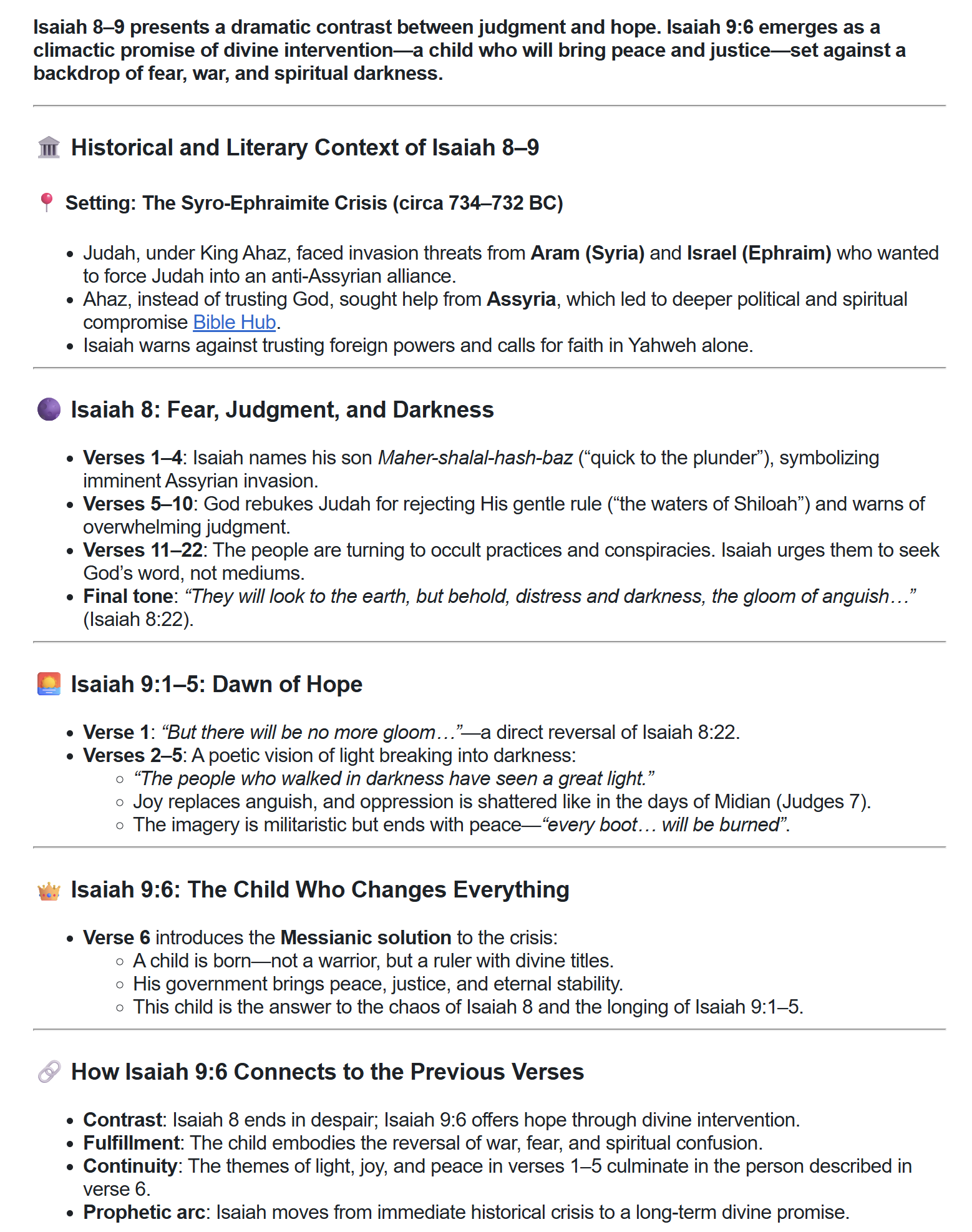
Could you tell me what was said in the previous eight verses or what’s said in the next twelve? What is written in verse nine has to be placed in context with the surrounding text and NOT singled out and twisted to support the christian dogma. Go back two more chapters where this section really begins and give a brief summary of what’s taking place in Judah.
November 9, 2025 at 11:52 am#947721DesireTruthParticipantRegarding Jesus’ qualifications for the eternal throne:
Jewish Messianic Criteria
Must be a descendant of David through Solomon (based on 2 Samuel 7 and 1 Chronicles 22).
Must be biologically descended from David, not just legally adopted.Nothing disagreeable here; your next statements are where the problem lies. You know the Jesus is suppose to be a biological descendant of David and Solomon; yet you/christianity have to justify away the glaring falsehood of Matthew and Luke’s genealogical accounts. One MUST ignore what G-d said to Moses in Numbers 1:2, 18 “2 Take the sum of all the congregation of the children of Israel, by families following their fathers’ houses; a head count of every male according to the number of their names.” “18 they assembled all the congregation on the first day of the second month, and they declared their pedigrees according to their families according to their fathers’ houses; according to the number of names, a head count of every male from twenty years old and upward.” Lineage ran through the father and NOT the mother. The mother has NOTHING to do with tribal lineage, so to say the Jesus’ lineage back to David ran through his mother is pure ignorance of what God established through Moses. This lineage justification through Mary is a lie; but, how would anyone know when most treat the Hebrew bible like a side note or a bunch of good stories. In short, Luke’s account is false. So much for the NT being the inspired, infallible, word of G-d. Matthew’s genealogical account has its own issues…and it’s BIG!
Matthew’s and Luke’s accounts also fail because the Jesus was conceived of the spirit and the messiah was to come from the seed (biological descendant) of a man (seed and egg come from whom…basic biology); AND we are told Joseph never slept with Mary (either she was r*ped or had relations with another). Since the Jesus was conceived by the spirit (aka G-d), that would make the Jesus a demigod like in Greek and Roman religions.
Stop relying on the words of others – including machines – and read with your own eyes and comprehend with your own mind.
November 9, 2025 at 12:10 pm#947722LightenupParticipant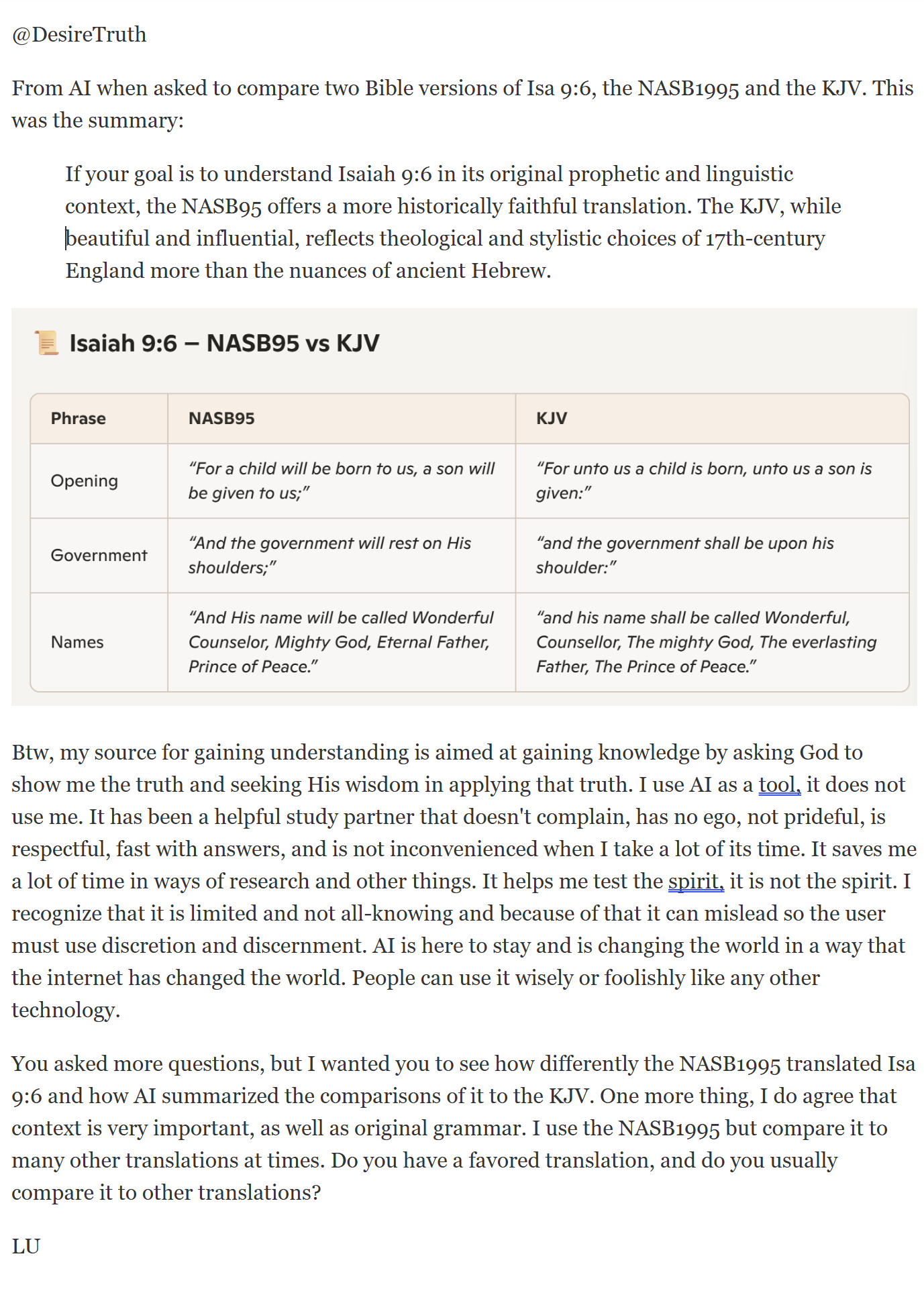 November 9, 2025 at 12:37 pm#947723LightenupParticipantNovember 9, 2025 at 1:00 pm#947724LightenupParticipant
Lost last two posts are screen shots that I took of AI answers to my questions. I am having trouble posting here, an error message keeps popping up and I have to do a work around and send through my email and them post a picture here via my phone. Keep in mind that the last post of mine does not reflect the NSB1995 version and I should have used that one for clarity.
LU
November 12, 2025 at 3:05 am#947737DesireTruthParticipantIf the questions you ask AI are christian geared, don’t you think the response will also be christian geared? Try a compare and contrast between the Hebrew and christian understandings and what type of answer you will receive. Ask:
What is the difference in understanding of Isaiah 9:6 in the Tanakh and KJV?
ChatGPT’s summary:
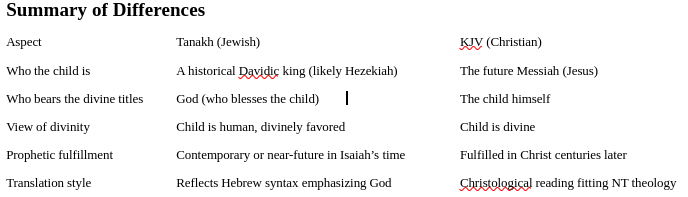
****ChatGPT can make mistakes. Check important info.****
I emphasized this disclaimer from ChatGPT; which admits it can make mistakes, the reason I don’t use it as a sole source and would never state what it returns as fact without verifying it; and because the results “agrees” with what I believe, doesn’t necessarily make it correct, now what?!?!?
AI is in its infancy and as it develops will become more prominent in our daily lives. What will happen, as people rely more on AI, is it will continue to dumb down our society as it takes over our everyday thinking. This may seem conspiratorial; but, as society continues to be dumb down, they become easier to control and if you can control the information they receive, how much easier will it be. Governments know this and so does the church; when was the last time you heard a pastor say to verify their words?
If we understand this section in the context it was written and word usage, there is nothing messianic about it; especially 700 years into the future. Explain why Ahaz would have needed to know about a messiah figure 700 years into the future when he’s about to be invaded. Wouldn’t death and captivity be a little more pressing? The christian belief doesn’t hold water and 9:6 isn’t a prophecy of a coming “messiah”; it’s about an immediate king who would lead and deliver them. NOT because that’s what AI says; it’s what the text says, a “child has been born to us, a son has been given to us”; this child/son is already alive and not coming in the far distant future. What good is knowing a saving king will come in 700 years when you’re about to be destroyed today…think about it. The christian understanding doesn’t make any sense in light of the events taking place. Learn more about Hezekiah in II Kings 16-20, II Chron 28-32, and Isa 36-39; Isaiah was a prophet for the Southern Kingdom during Hezekiah’s reign.
November 12, 2025 at 3:09 am#947738DesireTruthParticipantYou asked if I have a favorite translation and if I compare them to others. Don’t have a favorite translation; but, when reading the Tanakh I read from a Hebrew translation as that is the closest I can get to the original until I learn Hebrew.
Do I compare translations, the short answer, yes. My study aid ranges from software to online resources to hard copy or digitized books. What translation is your preferred?
I walked away from christianity and returned to G-d about two years ago and have never been more free.
- AuthorPosts

- You must be logged in to reply to this topic.