
- This topic has 121 replies, 4 voices, and was last updated 2 months, 4 weeks ago by
 DesireTruth.
- AuthorPosts
- October 14, 2025 at 7:38 am#947662
 LightenupParticipant
Great collection of verses on the Angel of the LORD.
The “angel” of the LORD is also the YHWH who is written about here:
The heir of all things, and through whom He made the universe. Heb 1:2
The radiance of God’s glory and the exact representation of His nature, upholding all things by His powerful word. Heb 1:3
One to be worshipped by all angels. Heb 1:8-9
YHWH who laid the foundations of the earth. Heb 1:10a
The heavens are the work of His hands. Heb 1:10b
The YHWH who will roll up the heavens and earth like a robe. Heb 1:12LU
October 14, 2025 at 7:57 am#947663LightenupParticipantUnity…let’s start here:
You wrote:
what does Deut 6:4 say: “…The Lord our G-d is one Lord.” Did you catch “G-d” and “Lord” in the same sentence and HE is one?
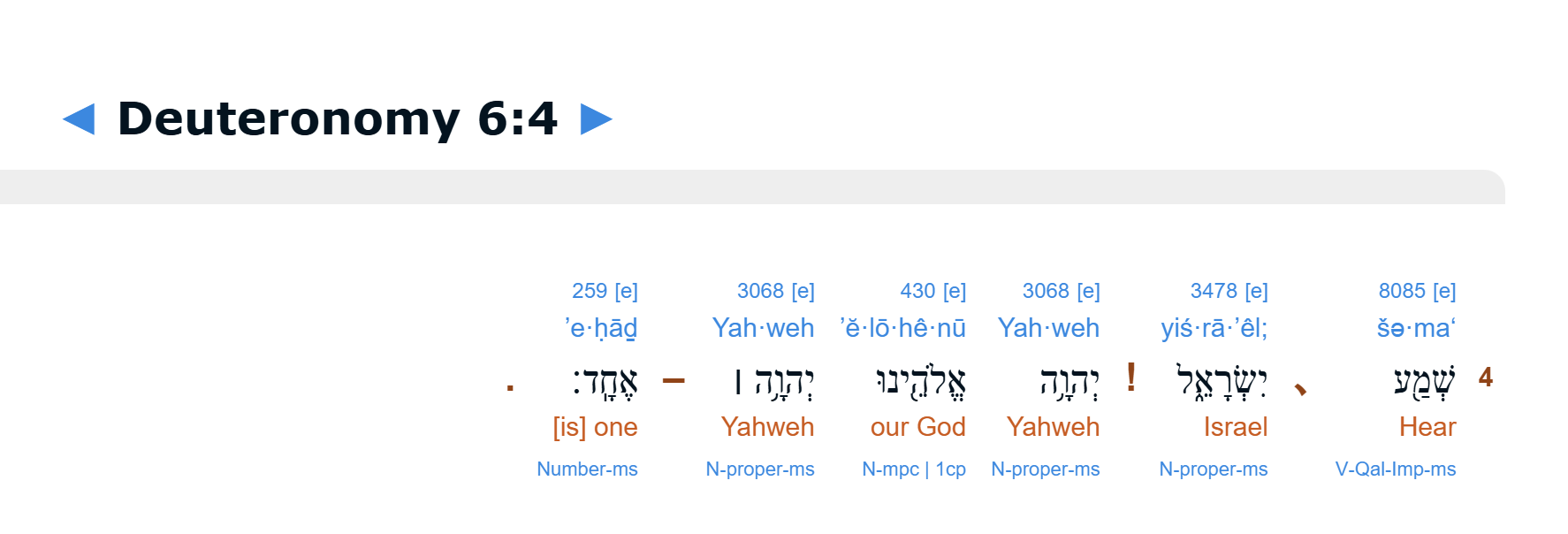
That is not really what Deut 6:4 says. I know it has been translated that way but it is not correct, popular but not correct. I am going to insert a picture of Deut 6:4 of the interlinear Bible that shows the Hebrew and the English and the parts of grammar. Please note that the verse is properly translated as “Hear Israel, Yahweh our God, Yahweh one.” Hebrew is read from right to left. The word “God” is plural, the last word is Strong’s #259 echad, meaning: One, single, first, alone, unity.
https://biblehub.com/interlinear/deuteronomy/6-4.htm
LU
October 19, 2025 at 4:13 pm#947667LightenupParticipant@Proclaimer @Berean @DesireTruth
When you understand that YHWH is a name for the fullness of God as well as the name of each presence of God, i.e. Father, Son and Holy Spirit, many things in the Bible become easier to understand. Give it a try, ask the Holy Spirit to illuminate this and open your heart and mind.
Be blessed, LU
October 21, 2025 at 6:53 am#947673 DesireTruthParticipant
You realize “Yahweh” is translated to “Lord”…right? So wouldn’t “Lord” also be an appropriate name to use?
When you understand that YHWH is a name for the fullness of God as well as the name of each presence of God, i.e. Father, Son and Holy Spirit
YHWH is yud, hei, vav, hei (Hebrew) and is the “unpronounceable” name of G-d; where does it say the meaning of the Tetragrammaton is the “fullness of G-d” and that it represents each of G-d’s “presences”?
Let’s look at the trinity claim (yes, it’s false; nowhere in the entire bible is the trinity mentioned, one must read between the lines to create it), the Jesus refers to himself as the “son of man” and most of the time it is others who call the Jesus “son of G-d.” G-d is spirit; so HE exists as two spirits; one for heaven and one for earth? The NT is where the “Holy Spirit” is mentioned as a separate being (in the King Jimmy the spirit of G-d is called a ghost…hmmm); in the Tanakh, holy is an adjective describing the Spirit of G-d. If the “HS” was a separate entity of G-d, why didn’t HE ever mention it to the Israelite nation?
You then focus on the word “echad” and highlight the meaning as “unity”; does the meaning of “echad” in the passage refer to a unifying G-d or a singular G-d? Strong’s says, “echad proclaims the exclusive, indivisible sovereignty of the covenant God over against polytheism” when referencing this passage. So according to Strong’s, the context of echad in this verse is the singular nature of G-d; that HE is ONE and NOT divisible as christianity has created HIM (trinity).
Don’t blindly accept what you have been told, verify it!
October 22, 2025 at 5:53 pm#947674LightenupParticipantYou ask:
where does it say the meaning of the Tetragrammaton is the “fullness of G-d” and that it represents each of G-d’s “presences”?
Deuteronomy 10:17
“For the LORD your God is the God of gods and the Lord of lords, the great, the mighty, and the awesome God, who does not show partiality, nor take a bribe.
I understand that verse to show that YHWH is God and Lord, two persons. They each have a spirit (the Spirit of the Father, the Spirit of the Son) united as one Holy Spirit. I use the term “fullness of God” to express the unity of Father, Son, and Holy Spirit. There are other contexts where the term YHWH or God seems to refer to only one of the persons and then other contexts it seems to refer to the other person.
This understanding helps me grasp how God can be three in one…three presences in one, not three persons in one.
You have other good questions in your post but to keep it less complicated, I addressed only one of them for now. My answer might help with your other questions. Let’s take things one at a time.
LU
October 24, 2025 at 1:19 am#947675DesireTruthParticipant“For the LORD your God is the God of gods and the Lord of lords, the great, the mighty, and the awesome God, who does not show partiality, nor take a bribe.”
I understand that verse to show that YHWH is God and Lord, two persons.
If I were to say my shirt is black and white, does that mean I have two shirts? Absolutely not!!!! It means my shirt has two colors, black and white. This grammatical concept is the same being used in the Deut 10:17 passage. This passage simply states YHWH is G-d above all other gods and Lord above all other lords/ruler. Confused how you read it speaking of two persons. Read the entire passage in context, Moses is speaking to Israel (verses 12-19) and tell me how G-d is being spoken of in a plural nature or a “son” is being referenced.
Since you are reading from the Jewish Bible (Tanakh), is this the Hebraic understanding of this passage or is it a modern religious interpretation? Second, by reading there are two persons being spoken of you have shifted away from monotheism to polytheism – multiple gods. This passage says nothing about G-d being two separate “presences” and to say G-d is represented by two “presences” in this passage contradicts Deut 6:4 where it says, “The LORD is our God, the LORD is one!”; AND why didn’t this passage mention a third “presence” to confirm the idea of G-d being three in one? I’m perplexed how you come to this conclusion when the words written don’t support your understanding, what teachings/faith do you follow?
The trinity is a taught belief and nowhere in scripture is the idea of G-d being a multiple person ever explicitly mentioned let alone taught by any of the writers. To say G-d is subdivided into multiple “presences” is to say HE is small. The funny part of the trinity belief is the Jesus is placed before G-d and most don’t see it or they say Jesus is G-d (G-d in the flesh).
Find a passage that explicitly speaks of G-d as being multi-natured, as understood by the doctrine of the trinity. If you can’t find a passage that confirms this idea, without reading between the lines, then is what you believe truth or a lie?
October 25, 2025 at 12:59 pm#947676LightenupParticipantAll good questions!
You wrote:
If I were to say my shirt is black and white, does that mean I have two shirts? Absolutely not!!!! It means my shirt has two colors, black and white. This grammatical concept is the same being used in the Deut 10:17 passage. This passage simply states YHWH is G-d above all other gods and Lord above all other lords/ruler. Confused how you read it speaking of two persons. Read the entire passage in context, Moses is speaking to Israel (verses 12-19) and tell me how G-d is being spoken of in a plural nature or a “son” is being referenced.
If I were to say: Israel is Jacob and sons. Would you agree that the statement shows that Israel is more than one person? If so, that is similar to how I read two persons in Deut 10:17. In the context of that chapter YHWH is the unity of the Father and the Son, YHWH our God. That is what makes sense to me in light of the whole Bible.
In Deut 6:4, YHWH is one, the Father and the Son together as YHWH, a unity. Israel is a unity of more than one person. A married couple is a unity of more than one person. If it were polytheism, they would be two separate gods, not united together as one YHWH God.
The united spirit is assumed when you realize they are two persons with their own spirit within. The Father, Son, and Spirit are sometimes together in a verse or passage but mostly just the Father and the Son are together in a verse or passage in the NT. Many people understand God as more than one person. YHWH is a unity of two persons both of the one eternal essence and both with their own spirit within them as I understand the scriptures.
To say G-d is subdivided into multiple “presences” is to say HE is small.
I’m not saying that YHWH God is divided into multiple presences as you suggest. Reproduction is a multiplication, not a division. The Son comes by asexual reproduction of the eternal essence before the ages and thus is a carrier of the eternal essence as well as the Father as I have come to understand.
Find a passage that explicitly speaks of G-d as being multi-natured
The second person of the unity, the Son, did take on flesh but before He took on flesh, He was in the form of God and was the exact representation of His Father’s nature.
Heb 1:3The Son is the radiance of God’s glory and the exact representation of His nature, upholding all things by His powerful word.
John 1:14And the Word became flesh, and dwelt among us, and we saw His glory, glory as of the only begotten from the Father, full of grace and truth.
15John testified concerning Him. He cried out, saying, “This is He of whom I said, ‘He who comes after me has surpassed me because He was before me.’”
16For of His fullness we have all received, and grace upon grace. 17For the Law was given through Moses; grace and truth were realized through Jesus Christ. 18No one has seen God at any time; the only begotten God who is in the bosom of the Father, He has explained Him.
Those two passage present two natures of the Son of God. He existed in the exact representation of His Father’s nature as would be obvious as His only begotten Son. And later the Son became flesh.
what teachings/faith do you follow?
I’m a Christian, I follow the Christian teachings, the Christian faith.
LU
October 29, 2025 at 5:31 pm#947677DesireTruthParticipantIf I were to say: Israel is Jacob and sons. Would you agree that the statement shows that Israel is more than one person?
You’re reaching and your analogy doesn’t work; you’re using an example of two physical separate identities and trying to make them one. Whereas G-d NEVER refers to HIMSELF as a multi “being”; christianity created that.
that is similar to how I read two persons in Deut 10:17. In the context of that chapter YHWH is the unity of the Father and the Son, YHWH our God. That is what makes sense to me in light of the whole Bible.
This statement summarizes christianity in a nutshell; it’s not about what is written in the bible, it’s about what one thinks it says and how one can make it align with one’s doctrines. When one changes the meaning of the words to whatever they want, the bible now becomes a literary work that’s open for personal interpretations verses being the solid, unchanging words of G-d.
The reality is we could dance back and forth trying to convince the other is wrong and that becomes a huge circle that gets no one anywhere. Here’s your challenge, prove with the Tanakh G-d is who you say HE is. Provide passages where G-d speaks of HIMSELF as a “trinity.”
October 30, 2025 at 1:14 pm#947678LightenupParticipantYou wrote:
You’re reaching and your analogy doesn’t work; you’re using an example of two physical separate identities and trying to make them one.
I am showing you that the name of the unity called Israel is made up of a man that God named Israel (Jacob) + Jacob’s sons. The unity called Israel is echad…one in a united sense of being more than one person. I wrote that so you can see that it is your understanding that seemingly understands the statement that Israel is Jacob and sons and that the word “Israel” isn’t one single being in that sentence. Look at the similarity and consider that it is your way of understanding, not the grammatical structure, of Israel and YHWH that shapes how you see Israel as a unity of people but YHWH not a unity of people. You are using what you think it says and how you can make it align with your doctrines.
Look at the structure of the two sentences:
Israel is Jacob and sons
YHWH is God of gods and Lord of lords
You are very correct that we could go back and forth and get nowhere. So, let me ask you if you know about the belief that enough early Jews (before Jesus came), believed that the Tanak was speaking about two powers of God, so much so, that the orthodox Jewish rabbis made a declaration about that belief?
October 31, 2025 at 5:16 am#947679DesireTruthParticipantYou are making no sense, obviously the nation of Israel came from Jacob and his sons; where does G-d claim to be more than one. Please provide the passages that support this “trinitarian” claim (do you notice how you are avoiding the question??).
Can we please finally put G-d/the Jesus “unity” of Deut 10:17 to rest; I understand grammar and christianity don’t mix, but for the rest of us it helps us understand the written form of communication and there are rules that must be followed.
Grammatically, “G-d is the G-d of gods and Lord of lords” is a simple sentence and is comprised of a subject (G-d), a helping verb (is), two prepositions (of gods, of lords), two predicate nominatives (G-d, Lord), and of course the conjunction “and” that joins the two predicates.
A predicate nominative is a noun or its equivalent that follows a linking verb and renames or explains the subject. For example: “Mr. Smith is our coach and teacher.” Coach and teacher refers back to Mr. Smith; it DOES NOT mean the coach is Mr. Smith and the teacher is the Jesus. Grammar is your friend! Hopefully we can now stop beating that dead horse and you can recognize the falsehood of what you believe (first step to recovery and out of idolatry)…there is no the Jesus in Deut 10:17 and it’s NOT speaking of “unity”! Do you see how reading between the lines or injecting personal beliefs creates misinterpretations, falsehoods, and corrupts religion?
Looking at your example “Israel is Jacob and sons”; Israel is a nation that consists of more than Jacob and his sons. The decedents of Jacob’s sons is what eventually formed the nation of Israel 400 years later when G-d freed them from slavery; your analogy still doesn’t work and isn’t the same as the Deuteronomy passage; nice try, but guess again.
October 31, 2025 at 5:18 am#947680DesireTruthParticipantSo, let me ask you if you know about the belief that enough early Jews (before Jesus came), believed that the Tanak was speaking about two powers of God, so much so, that the orthodox Jewish rabbis made a declaration about that belief?
Don’t be a tease, back up what you say; provide proof to that statement and the “two powers” of G-d.
October 31, 2025 at 6:11 am#947681LightenupParticipantWe can take a slight pause on the Deut 10 :17 after you give me an analogy that is not comparing apples to oranges and shows that you are grasping the pattern. Make it follow this form: the name of a unity of persons = the title or category of each member in the unity.
Israel is the name of a unity, the House of Jacob. Israel=Jacob (who is called Israel, btw) + his sons (i.e descendants). This is true genealogically (the nation begins with them), nationally (all Israelites descend from them), and biblically (Scripture uses “Israel” and “Jacob” synonymously for the people, btw.).
Genesis 46:8 – “These are the names of the descendants of Israel (that is, Jacob) who went to Egypt…”
Numbers 23:7 – “Come, curse Jacob for me; come, denounce Israel!”
Psalm 105:10 – “He confirmed it to Jacob as a decree, to Israel as an everlasting covenant.”
Show that you can grasp that pattern and we can move on, DesireTruth. I don’t want to belabor the point either.
October 31, 2025 at 7:00 am#947682LightenupParticipantI’m happy to tell you about the Two Powers of God, actually referred to as the “Two Powers of Heaven”.
The concept of “two powers in heaven” (often described as binitarianism in modern scholarship) refers to an early Jewish theological framework that posited two divine figures or manifestations sharing authority in the heavenly realm, while maintaining strict monotheism. Both “powers” were understood as aspects of the one God (Yahweh), not separate deities: typically, an invisible, transcendent God (the “Ancient of Days” or sovereign Yahweh) and a visible, agent-like second power (often a vice-regent or hypostasis, such as the Angel of the Lord, Wisdom, or the Son of Man). This belief was not fringe but widespread in Second Temple Judaism (ca. 516 BCE–70 CE), emerging from interpretations of the Hebrew Bible and developing through apocalyptic and wisdom literature. It provided a way to reconcile God’s unity (Deuteronomy 6:4, the Shema) with scriptural depictions of divine plurality
You might be interested in the book by Alan F. Segal entitled “Two Powers in Heaven”.
LU
November 1, 2025 at 2:32 am#947685DesireTruthParticipantWe can take a slight pause on the Deut 10 :17 after you give me an analogy that is not comparing apples to oranges and shows that you are grasping the pattern.
Not trying to grasp a “pattern”; I’m looking at the grammatical structure of the sentence…facts. Did you not read the grammar break down of the sentence? This concept is from a seventh grade grammar book. I have no idea what you are trying to accomplish as I have no idea what this “unity” thing is you’re trying to get me to understand; you aren’t explaining it very well. You originally asked if I agreed there was a theme of unity through out scripture and I asked for clarification – unity of what. What I got was Deut 10:17 that has nothing to do with “unity”, but Moses speaking to the people telling them (context of the entire passage) to love the alien among them because they were once an alien of a foreign land and to love, serve, obey, and worship G-d. Nowhere in the entire passage does it speak of a unity between G-d and the Jesus and the grammatical structure of verse 17 is speaking of G-d and G-d alone. Your religion made the Jesus addition up. Then you jump to Israel = Jacob + sons; as if this was to clear everything up; I can’t read your mind, so don’t assume I know what you are referring…explain it.
Your analogy of Jacob (renamed Israel) and his sons being some kind of “unity” makes sense that they are a family unit; but to extrapolate they are the nation of Israel is absurd. It’s the descendants that became the nation of Israel; 400 years later in the desert. If this isn’t what you are speaking of, hate to be crude, but start over and communicate what you want to say in a more coherent way because we are obviously on two separate pages. I don’t have the time to figure out what your trying to communicate, just say it. Don’t hide your question in a statement, just asked it. Also, this is the reason I asked for your faith, so I have an idea with whom I am speaking; to say “christiain” is rather broad. Since walking away from “christianity”, I would find myself aligning more with Noahide.
Concerning the “two powers of heaven”, please provide scripture that supports this modern understanding. Please provide scriptural evidence the “Israelite’s knew two Yahwehs—one invisible, a spirit, the other visible, often in human form.”
November 2, 2025 at 3:18 am#947686LightenupParticipantRegarding the “two powers in Heaven” it is easier for me to just copy and paste the information from GROK. It saves me quite a lot of time trying to explain. Here it is word for word:
Overview of “Two Powers in Heaven” in Early Judaism
The concept of “Two Powers in Heaven” (often rendered from the rabbinic Hebrew shnei rashuyot ba-shamayim) refers to a theological motif in Second Temple Judaism (roughly 516 BCE–70 CE) and early rabbinic literature, where God’s sovereignty is shared or mediated by a second divine figure or “power.” This second power is not an equal rival (as in Persian dualism) but a subordinate yet exalted agent—such as an angel, the divine Word (Logos), Wisdom (Sophia), or a messianic Son of Man—who participates in creation, judgment, or revelation. Far from being a fringe idea, it was a legitimate interpretive framework drawn from biblical texts, but it became controversial in later rabbinic Judaism, eventually labeled a heresy around the 2nd century CE, partly in response to Christian appropriations.This motif challenges the stereotype of Judaism as strictly monotheistic in a modern sense, revealing a more “binitarian” (two-in-one) fluidity in early Jewish thought. It influenced early Christian Christology (e.g., viewing Jesus as the incarnate second power) and Gnosticism, but its roots are firmly Jewish.
Biblical Foundations
The idea emerges from ambiguous passages in the Hebrew Bible (Tanakh) that depict God (Yahweh) alongside a second figure who bears divine attributes, such as enthronement, worship, or creative agency. Key examples include:Daniel 7:9–14: Describes the “Ancient of Days” (God) on a fiery throne, followed by “one like a son of man” who approaches on clouds, receives everlasting dominion, and is served by all peoples. Early Jewish interpreters (e.g., in 1 Enoch) saw this as a heavenly messiah or exalted human figure distinct from yet subordinate to God.
Exodus 23:20–23: God promises to send an “angel” (mal’ak, often “messenger”) who bears God’s name, forgives sins, and demands obedience equal to God’s. This figure is sometimes identified as a visible manifestation of Yahweh himself.
Exodus 15:3: Yahweh as a “man of war,” paired with warrior imagery in broader ancient Near Eastern contexts, suggesting a visible divine agent alongside the invisible God.
Proverbs 8:22–31: Personified Wisdom (Hokhmah) as God’s co-creator, begotten before creation, and delighting in humanity—later expanded in texts like Sirach 24 and Wisdom of Solomon as a semi-divine intermediary.
These texts imply “two Yahwehs”: one transcendent and invisible, the other immanent and visible, often in human form. As scholar Michael Heiser notes, this reflects an Israelite adaptation of ancient Near Eastern divine council motifs, where a high god (El) rules through a vice-regent (e.g., Baal).Development in Second Temple Judaism
During the Second Temple period, this binitarian idea proliferated in diverse Jewish sects (Pharisees, Essenes, Sadducees, and apocalyptic groups), without being seen as polytheistic. It was not tied to one group but appears across literature:Apocalyptic Texts: In 1 Enoch (2nd–1st century BCE), the “Son of Man” or “Elect One” is pre-existent, enthroned beside God, and executes judgment (e.g., 1 Enoch 48–49, 62). Similarly, 4 Ezra (1st century CE) portrays a messianic figure from the sea who pre-existed with God.
Philonic Judaism: The philosopher Philo of Alexandria (ca. 20 BCE–50 CE) explicitly describes the Logos (divine Word) as a “second God” or intermediary, protecting God’s immutability while engaging the world (e.g., De Confusione Linguarum 62–63). For Philo, this upholds monotheism by distinguishing the transcendent Father from the active Son/Logos.
Wisdom Literature: Texts like Wisdom of Solomon (1st century BCE) depict Wisdom as God’s “effulgence” and partner in creation, echoing Proverbs but elevating her to near-divine status.
Dead Sea Scrolls: Fragments suggest exalted angelic figures (e.g., Melchizedek in 11QMelchizedek) who perform priestly or judicial roles on God’s behalf.
Scholars like Alan F. Segal argue these ideas were “orthodox” until the 2nd century CE, rooted in exegesis rather than foreign influence. Daniel Boyarin extends this, viewing “two powers” as one of several “options for Jewish belief” in the 1st century, not yet a heresy.Rabbinic Response and Heresy
Post-70 CE, as rabbinic Judaism consolidated after the Temple’s destruction, the motif faced scrutiny. Early rabbis (Tannaim, 1st–2nd centuries CE) debated it in the Mishnah and Talmud, often linking it to minim (“heretics,” possibly including Jewish-Christians or Gnostics).Mishnah Sanhedrin 4:5: Warns against saying “there are many ruling powers in heaven,” implying a broader divine council but rejecting multiplicity.
Babylonian Talmud, Berakhot 33b: Prohibits repeating “Barukh attah Adonai” consecutively in blessings, lest it imply thanking “two powers.”
Talmudic Polemics: Rabbis like Akiva initially entertained exalted figures (e.g., Metatron as a near-divine angel in 3 Enoch), but later traditions condemned “two powers” believers, associating them with idolatry or dualism.
Peter Schäfer and others suggest this “heresy” label was retrospective border-making: rabbis retrojected anathema onto pre-70 CE ideas to define orthodoxy against Christianity, where Jesus became the second power. Segal dates the formal condemnation to ca. 200 CE, post-Bar Kokhba revolt (132–135 CE), when Jewish identity hardened.Significance and Scholarly Debate
The “two powers” motif illuminates early Judaism’s theological diversity, bridging monotheism with intermediary figures—a “parting of the ways” with Christianity. As Boyarin puts it, it wasn’t “borrowed” by Christians but was “Jewish theology” that evolved differently.Key scholarly works:
Author
Title
Key Contribution
Alan F. Segal (1977)
Two Powers in Heaven: Early Rabbinic Reports about Christianity and Gnosticism
Seminal study tracing rabbinic evidence; argues pre-Christian Jewish roots, heresy post-2nd century CE.amazon.combaylorpress.com
Daniel Boyarin (2012)
The Jewish Gospels
Frames it as binitarian Judaism, not Christian innovation; critiques “heresy” as rabbinic invention.earlywritings.com
Peter Schäfer (2009)
The Origins of Jewish Mysticism
Explores Merkabah links; sees it in broader Jewish-Christian polemics.answeringislamblog.wordpress.com
Michael Heiser (ongoing)
Two Powers in Heaven resources
Biblical focus; posits vice-regent model from ancient Near East.twopowersinheaven.comdrmsh.comThis concept remains debated: some (e.g., Schäfer) see it as marginal mysticism, others (e.g., Boyarin) as mainstream. For deeper reading, Segal’s book is foundational.
LU
November 2, 2025 at 5:58 am#947687DesireTruthParticipantI asked for scriptural proof and NOT writings of a scholar christianizing the Jewish scripture with his thoughts.
Daniel 7:9–14: Describes the “Ancient of Days” (God) on a fiery throne, followed by “one like a son of man” who approaches on clouds, receives everlasting dominion, and is served by all peoples. Early Jewish interpreters (e.g., in 1 Enoch) saw this as a heavenly messiah or exalted human figure distinct from yet subordinate to God.
We can all agree this passage is speaking of G-d and the coming Messiah; and has nothing to do with “two powers of heaven.” Also, where is I Enoch; I haven’t found this book in the Tanakh.
Exodus 23:20–23: God promises to send an “angel” (mal’ak, often “messenger”) who bears God’s name, forgives sins, and demands obedience equal to God’s. This figure is sometimes identified as a visible manifestation of Yahweh himself.
The “visible manifestation” of G-d?!? NO! G-d’s authority is with this angel and is a representative of HIS. Nowhere in the passage does it suggest that this angel is a manifestation of G-d.
Exodus 15:3: Yahweh as a “man of war,” paired with warrior imagery in broader ancient Near Eastern contexts, suggesting a visible divine agent alongside the invisible God.
“The LORD is a warrior, the LORD is his name.” This is part of a song the Israelite’s sung to G-d; not seeing any reference to “two powers of heaven.”
Proverbs 8:22–31: Personified Wisdom (Hokhmah) as God’s co-creator, begotten before creation, and delighting in humanity.
If “as God’s co-creator” wasn’t included in this sentence, this is an agreeable statement. This entire chapter is personifying wisdom, NOT saying it’s G-d. As a Jewish sage wrote of this chapter:
Wisdom’s Speech: The previous sections offered mainly practical wisdom, including counsel to young people on how to conduct themselves and what to avoid, as well as a description of seductive wisdom using the imagery of a strange woman. This section depicts a different aspect of wisdom and consists mainly of a poetic soliloquy delivered by an anthropomorphized wisdom. This is a unique speech in the book of Proverbs and, indeed, in the Bible as a whole. Wisdom is described here from its greatest heights down to its lowest levels, from subjects that go beyond metaphysics and the upper worlds to everyday advice given to a young man venturing forth into the world.
November 2, 2025 at 1:02 pm#947697LightenupParticipantAt least you now know that the belief of two powers in Heaven, held by enough people as a legitimate interpretive framework drawn from biblical texts as early as 560 BCE, is not a modern interpretation.
Have you heard of the Targums?
LU
November 2, 2025 at 1:35 pm#947700 ProclaimerParticipant
When you understand that YHWH is a name for the fullness of God as well as the name of each presence of God, i.e. Father, Son and Holy Spirit, many things in the Bible become easier to understand. Give it a try, ask the Holy Spirit to illuminate this and open your heart and mind.
When God is understood as more than one person, that is, two (Binity), or three (Trinity), then it absolutely takes a wrecking ball to scripture.
Try replacing the word ‘God’ in any of the 100 verses below (or any other verse) with the word ‘Trinity’ (or Father, Son, Holy Spirit). E.g. John 3:16
“For God so loved the world that he gave his one and only Son, that whoever believes in him shall not perish but have eternal life.Becomes: “For THE TRINITY so loved the world that THE TRINITY gave his one and only Son, that whoever believes in him shall not perish but have eternal life.
And if you think Jesus is God and the creator, then also try replacing each instance of God with Jesus. So now you have: For JESUS so loved the world that JESUS gave his one and only Son, that whoever believes in him shall not perish but have eternal life.
Above we can see that if God were truly a Trinity or if Jesus were God, then Jesus has to be the son of the Trinity which doesn’t make sense or Jesus has a son. So clearly the biblical writers did not see God or Jesus in the same light that many do today.
Try some of the verses below and see how the Trinity Doctrine breaks the true meaning of all these verses. When you are done, now give me the biggest fake explanation you can come up with to try and explain away this elephant in the room.
Matthew 27:46
Mark 1:24
Mark 10:18
Mark 15:34
Mark 16:19
Luke 2:52
Luke 6:12
Luke 18:19
John 3:2
John 8:42
John 8:54
John 9:3
John 13:31
John 14:1*
John 17:3
John 20:17
Acts 2:22
Acts 2:32
Acts 2:36
Acts 3:13
Acts 4:10
Acts 5:30
Acts 7:55
Acts 10:36
Acts 10:38
Acts 13:23
Acts 20:21
Romans 1:7
Romans 1:8
Romans 2:16
Romans 3:22
Romans 4:24
Romans 5:1
Romans 5:11
Romans 5:15
Romans 5:17
Romans 6:23
Romans 7:25
Romans 8:34
Romans 10:9
Romans 15:5
Romans 15:6
Romans 16:27
1 Corinthians 1:3
1 Corinthians 1:9
1 Corinthians 1:30
1 Corinthians 8:6
1 Corinthians 15:57
2 Corinthians 1:2
2 Corinthians 1:3
2 Corinthians 11:31
2 Corinthians 13:14
Galatians 1:1
Galatians 1:3
Ephesians 1:2
Ephesians 1:3
Ephesians 1:17
Ephesians 2:6
Ephesians 6:23
Philippians 1:2
Philippians 2:11
Colossians 1:3*
Colossians 3:17
1 Thessalonians 1:1
1 Thessalonians 1:3
1 Thessalonians 3:11
1 Thessalonians 3:13
1 Thessalonians 4:14
1 Thessalonians 5:9
2 Thessalonians 1:1
2 Thessalonians 1:2
2 Thessalonians 1:12
2 Thessalonians 2:16
1 Timothy 1:1
1 Timothy 1:2
1 Timothy 2:5
1 Timothy 5:21
1 Timothy 6:3
2 Timothy 1:1
2 Timothy 1:2
2 Timothy 4:1
Titus 1:4
Titus 2:13
Philemon 1:3
Hebrews 13:20
James 1:1
1 Peter 1:2
1 Peter 2:5
2 Peter 1:1
2 Peter 1:2
1 John 5:1*
1 John 5:20
2 John 1:3
Jude 1:1
Jude 1:4
Jude 1:21
Jude 1:25
Revelation 1:1
Revelation 1:2
Revelation 14:12November 2, 2025 at 4:04 pm#947701DesireTruthParticipantThe trinity explained at last. LOL
The trinity teaches God sent himself to go to earth to save mankind.
Then he agreed with himself and volunteered himself to himself to offer himself.
Then God Impregnated a woman as himself with himself.
God Prayed to himself and glorified himself repeatedly.
God strengthened himself and prayed to himself.
While dead, he resurrected himself so he could exalt himself above himself.
The he sat at his own right hand and waited till he placed his enemies as a footstool.
Finally, with Satan’s forces defeated, God would turn his kingdom over to himself that all things would become everything to himself.
The trinity is a false teaching and is nowhere within the Jewish scriptures or the NT. If you believe in the trinity, you believe in three gods not one.
November 2, 2025 at 4:43 pm#947702DesireTruthParticipantAt least you now know that the belief of two powers in Heaven, held by enough people as a legitimate interpretive framework drawn from biblical texts as early as 560 BCE, is not a modern interpretation.
Have you heard of the Targums?
Did Moses, Joshua, the Judges, or the prophets teach G-d as a “bi-unity” or more importantly, did G-d ever claim HE existed as “two powers”?
Did you mean “Talmud” verses “Targum”? The Targum was the Hebrew bible translated into Aramaic.
Let’s look at Exo 23:20-23 in the Targum and see if we can find a reference to “two powers.”
20 Behold, I will send an angel before you, to guard you on the way, and to bring you to the place that I have prepared. 21 Be careful in his presence and heed [obey] his voice [word]. Do not rebel against him; for he cannot bear [pardon] your transgression, as [in] My Name is in him [his word]. 22 But if you truly listen to [obey] his voice [word], and do all that I speak, then I will be an enemy to your enemies, and attack those who attack you. 23 My messenger will go before you, and will bring you into [the land of] the Emorites, the Chittites, the Perizzites, the Canaanites, Chivites, and the Yevusites, and I will then annihilate them.
I personally don’t read a “two power” G-d in the Targum either; I read G-d giving his authority to an angel; the angel acting as a representative of HIS. I want scriptural references that state G-d is “two powers.” If none exist, how can you continue to support and push such a teaching?
- AuthorPosts
- You must be logged in to reply to this topic.